
ICT Killzones — The 4 Session Windows Where Trading Happens (ET)
The forex market runs 24 hours a day, and crypto doesn't even pause for holidays — but that doesn't mean every hour is worth trading. Most of the daily range is built inside a few narrow windows when institutional capital enters the market. Michael Huddleston (ICT) called these windows killzones and defined four of them: Asian, London, New York and London Close. This article is the pillar of our whole time-and-sessions section: you'll find every window's hours in New York time (ET), the character of each one, and a concrete game plan — for BTC, ETH and currency pairs.
What Are the ICT Killzones
A killzone is a time window of elevated volume and volatility, driven by the activity of banks, funds and market makers where the big sessions meet: Sydney, Tokyo, London and New York. The idea is simple: instead of sitting in front of the chart all day, you wait for the hours when the market actually has fuel to move — and only then look for an entry.
In the ICT method, killzones aren't an add-on — they're half of the equation. The whole "time and price" philosophy says a good level without the right time is worthless: a liquidity zone or an FVG is most likely to work when price reaches it inside a killzone, because only then does real order flow stand behind it. Outside the windows the market mostly drifts — and it's precisely in that drift that beginners give back the most money.
Killzones are also the skeleton for the rest of ICT's time concepts: Macro Times are the precise minutes inside the windows, the Asian Range builds the base that London sweeps, and the intraday profiles describe how these windows combine into the scenario of the whole day.
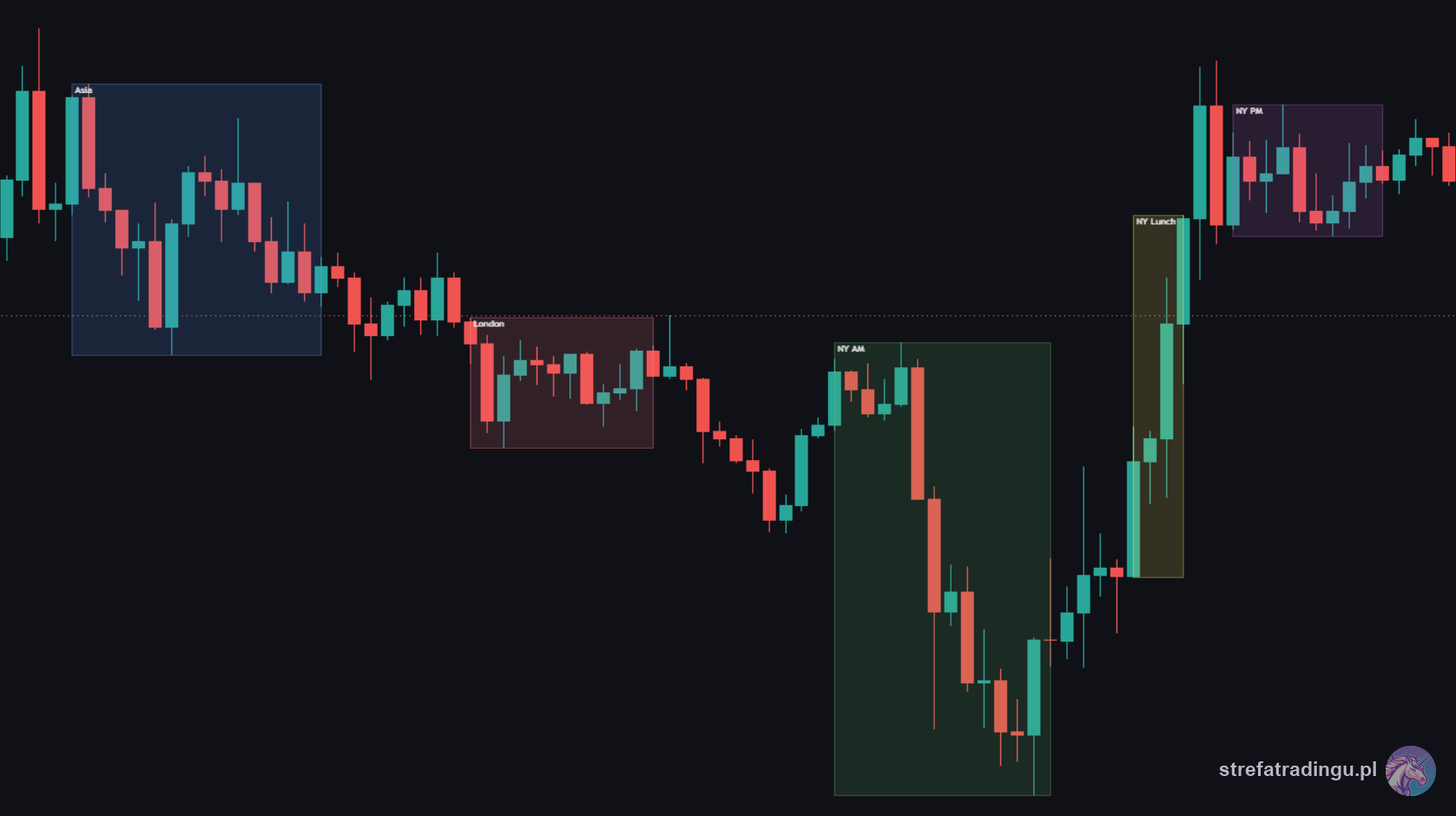
Killzone Hours (New York Time)
ICT anchors everything to New York local time — and so do we. All hours below are in ET.
| Killzone | New York Time | Character |
|---|---|---|
| Asian | 8:00 PM – 12:00 AM | low volatility, range building |
| London | 2:00 AM – 5:00 AM | the strongest directional move of the day |
| New York | 7:00 AM – 10:00 AM | London+NY overlap, biggest volume of the day |
| London Close | 10:00 AM – 12:00 PM | correction back into the day's range |
One table for the whole blog. These hours apply across every article on Strefa, and we count the New York lunch as 12:00–1:00 PM ET. Other sources use variants — for example an Asian killzone starting at 7:00 PM ET, or a New York window of 8:30–11:00 AM ET. Some ICT models, such as the One Trading Setup or Bread and Butter, run on their own windows — and when they do, the article about the model says so explicitly.
Watch out for daylight saving time. The US switches to DST on the second Sunday of March and back on the first Sunday of November, while Europe changes its clocks on different weekends (the last Sundays of March and October). If you trade from outside the US, your local offset to New York shifts by an hour for a few weeks each year. The simplest fix: set your chart in TradingView to the "New York" timezone and read the hours straight from the table — DST stops being your problem. You can also check the current session window and AMD phase live in our NEXUS market-time widget (nexus.strefatradingu.pl), which tracks these shifts for you.
Asian Killzone (8:00 PM – 12:00 AM ET)
The quietest window of the day. The dollar usually consolidates, so on forex the movers are mainly JPY, AUD and NZD pairs, while BTC and ETH build a tight range that will become liquidity for the rest of the day. For most Western traders this is the overnight window — but the range it leaves behind is the foundation of Asian Range setups. All you have to do afterwards is mark it.
London Killzone (2:00 AM – 5:00 AM ET)
Statistically the strongest directional window of the day. On a down day London very often sets the high of the day; on an up day — the low. The classic sequence: a sweep of the overnight range's high or low, a shift in structure, and a directional move of several dozen pips (on BTC — often more than a percent). On forex, GBP/USD and EUR/USD rule this window.
New York Killzone (7:00 AM – 10:00 AM ET)
The overlap of the London and New York sessions plus the NYSE open at 9:30 AM ET — the biggest volume of the day. Price often corrects here into the range London built, and the day's second leg launches from that correction. It's also home to the strongest Macro Times window: 9:50–10:10 AM ET. Best instruments: USD pairs, indices (NQ, ES), gold — and crypto, which moves together with the indices during these hours.
London Close Killzone (10:00 AM – 12:00 PM ET)
European desks close their positions before their day ends, so price usually corrects back into the daily range. If the day has already printed its high or low, London Close offers the last decent setup of the day — most often a quick scalp against the last move, targeting the inside of the day's range.
How to Use Killzones in Your Trading
A killzone is not a signal by itself — it's a time filter you lay over your normal analysis. A template you can repeat in every window:
- Set the day's bias before the window opens. On D1/H4 decide whether the day looks bullish, bearish or unreadable. Unreadable = skip the window.
- Mark the liquidity targets. The previous day's and previous session's high and low, equal highs/lows, unfilled FVGs — everything that can attract price. Details in the article on liquidity pools.
- Wait for the window to open. Entering before the killzone throws away the whole edge — the catalyst of the move is order flow that only starts when the window opens.
- Watch for the sweep. The first move of a killzone is usually a liquidity grab: London sweeps the Asian high/low, New York — London's extreme. The sweep is not the day's direction, only its announcement.
- Wait for the market structure shift (MSS). After the sweep, the lower timeframe (M5–M1) must break structure in the direction of your bias. Without it, an entry is guessing.
- Enter on the retrace. Into the FVG, the order block or the OTE zone left behind by the impulsive move. Stop beyond the swept extreme, target at the opposite liquidity pool.
The exact same template works on crypto — with one adjustment: measure ranges in percent or through ATR instead of pips, because BTC in the New York killzone can cover in an hour what it does all Asian night.
Here's a model down day mapped onto the windows. Overnight (8:00 PM – 12:00 AM ET): BTC builds a tight range — you mark its high and low. London (2:00 – 5:00 AM ET): price pokes a few tenths of a percent above the overnight high, traps the buyers, and after an M5 structure shift rolls over — the high of the day has just been printed. New York (7:00 – 10:00 AM ET): price corrects part of the decline into the FVG London left behind, and from that correction delivers the second leg down. Late morning (10:00 AM – 12:00 PM ET): London Close bounces off the low back into the daily range. Four windows, one coherent scenario — and three different places where you could have traded the same direction.
Match the window to your lifestyle too. If you have a day job, pick the window that actually fits your clock: for a US East Coast trader the New York killzone (7:00–10:00 AM ET) and London Close (10:00 AM–12:00 PM ET) are the natural home, while the London killzone means an early alarm — for a European trader the roles reverse. Better to master one window to perfection than to chase all four.
Common Mistakes
- Entering before the window opens. If you trade killzones precisely because institutional flow only shows up inside them, a position opened earlier plays against your own strategy.
- Trading every window every day. Not every killzone has a readable bias and a clean liquidity target. Four windows a day are not four mandatory trades — they're four chances, most of which should be skipped.
- The wrong instrument in the wrong window. GBP during the Asian night or AUD in the New York killzone gives choppy, unreadable price action. The instrument has to match the session that trades it.
- Entering into the sweep instead of after it. The first move of a window is usually a stop hunt. Whoever buys the break of the Asian high in the first minutes of London has usually just handed liquidity to the institutions.
- Ignoring the DST shift. Twice a year the windows move by an hour relative to your local clock. A week of trading the "old" hours can wreck a whole month of stats. A chart set to New York time solves the problem once and for all.
- Trading a window with news inside it. A macro release (CPI, a Fed decision, NFP) inside a killzone distorts price action. You check the calendar before the window, not after the loss.
Killzones are the clock the whole ICT methodology runs on. You'll meet the other hands of that clock in the articles on Macro Times — the minute-level algorithm windows inside the sessions, the Asian Range — the overnight base of the day, and the intraday profiles, which assemble all the windows into a single daily scenario. Start with a simple step, though: for one week, just watch what your market does between 2:00 and 5:00 AM ET and between 7:00 and 10:00 AM ET. The difference versus the rest of the day will be visible to the naked eye.
FAQ
When are the ICT killzones?
What is the best ICT killzone to trade?
Do ICT killzones work on crypto if BTC trades 24/7?

Trader and founder of Strefa Tradingu. He’s been breaking crypto down on YouTube for years — no hype, no signals, with a focus on market structure and risk management.
🎁 Grab Strefa’s free TradingView indicators
Drop your email — we’ll send you links to our free TradingView indicators plus a no-fluff starter kit. Zero spam.
Thank you! Check your inbox. If the email is not there, look in the Promotions tab or in spam and move it to your inbox.