
Judas Swing — The False Move at Session Open
It's 3:15 AM ET and London has just opened. BTC, flat all night, suddenly rockets higher — the chart turns green and the "pump" calls start on Twitter. Fifteen minutes later price is below where the spike began, and the longs opened "on the breakout" have just handed over their stops. If that movie looks familiar, you've already met the Judas Swing — just from the wrong side. It's one of the most repeatable session-open mechanisms in the entire ICT method: a false move designed to collect liquidity before the day's real direction. In this article we learn to recognize it, wait for it to complete and trade what comes AFTER the betrayal — instead of being its fuel.
What the Judas Swing Is
The Judas Swing is an engineered, false move at the session open, directed against the true bias of the day. The mechanics are always the same: price spikes one way, collects stops and pulls in breakout traders, then reverses and spends the rest of the session travelling in the opposite — correct — direction.
The name is deliberately blunt. It refers to Judas — the betrayer — and to the "Judas goat" of the old slaughterhouses: an animal trained to lead the herd to slaughter and walk back out safely itself. The opening move plays exactly that role: it leads the crowd in a direction there is no coming back from, and leaves them there.
In the bigger frame, the Judas Swing is simply the manipulation phase of the Power of 3 (AMD) model seen up close, through the lens of the session open. AMD describes the full daily cycle; the Judas is its most treacherous fragment — and at the same time the best moment to understand which side of the market you want to stand on.
Two parameters are key: the reference level and the time window. The reference level is the day's opening price at midnight New York time (00:00 ET). The window in which the Judas usually prints stretches from that midnight to about 5:00 AM ET, with the textbook variant fitting into the first two hours (midnight–2:00 AM ET) and many setups printing only after the London open at 3:00 AM ET — in the intraday profiles that's a delayed protraction. A "Judas-style" move at 8:00 AM ET is not a Judas Swing; the clock belongs to the definition of the setup just as much as price does.
The bullish and bearish variants are mirror images of each other. With a bullish bias, the Judas is a fast dive BELOW the opening price — it collects buyers' stops and pulls in shorts, then the market turns back up. With a bearish bias, the Judas is a spike ABOVE the open — it collects sellers' stops and pulls in longs, then the market heads down.
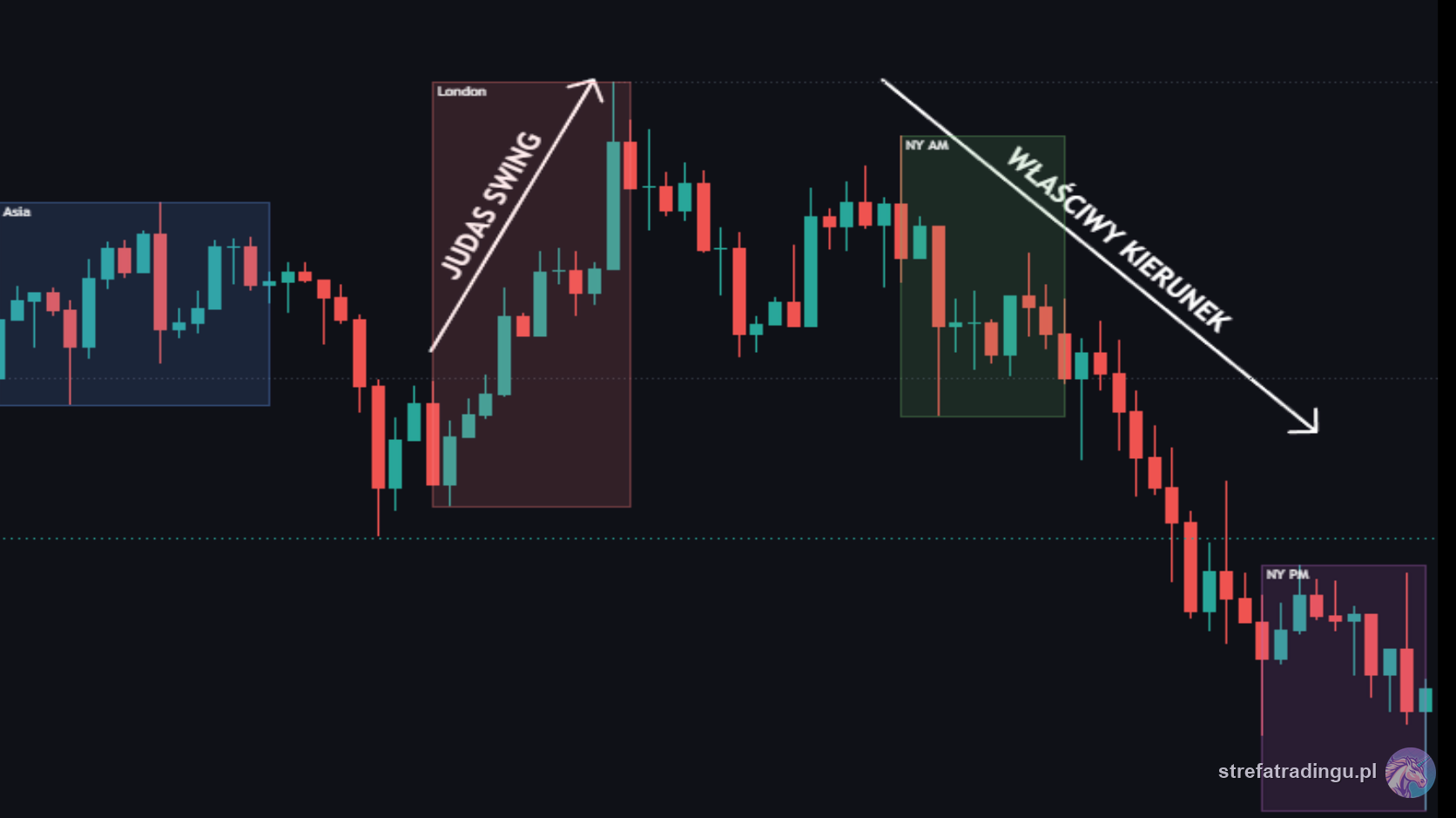
Setup Conditions Step by Step
The Judas Swing is a directional setup — its entire logic rests on the false move running against the bias. Without a bias you don't know which side is the betrayal. The checklist:
- Set the day's bias on D1/H4. Market structure, the nearest liquidity target, premium/discount context. No readable bias = no setup, no matter how pretty the open looks.
- Mark the opening price from 00:00 ET. This is the level against which you measure the whole manipulation. On TradingView, the easiest way is to set the chart to the New York time zone and drop a vertical line at midnight.
- Wait for the midnight–5:00 AM ET window. Highest alert from 3:00 AM ET, i.e. from the London open.
- Watch for the false move against the bias. Bullish bias → a dive below the open, in the ideal scenario also sweeping nearby old lows or the low of the Asian Range. Bearish bias → a spike above the open, into the stops above old highs.
- Confirm the move's failure. Price must come back through the opening level. A move that closes beyond the open and stays there is a candidate for a real breakout, not a Judas. In that case you stand down.
- Drop to M5–M1 and wait for an MSS in the direction of the bias. The structure shift is what separates the betrayal from the real move — and separates trading from guessing.
- Mark the entry zone from the displacement leg. The FVG or Order Block left behind by the structure-breaking candle.
- Enter on the retest of the zone, stop beyond the Judas extreme — beyond the swept low (long) or high (short), with a buffer, because the extreme sometimes gets "touched" one more time.
- Target: liquidity in the direction of the bias — the previous day's high for a long, the previous low for a short; more on choosing targets in the article on liquidity pools.
The Judas on Crypto — What Changes in a 24/7 Market
The model was born on indices and forex, but on BTC and ETH it works surprisingly well — provided you make a few adjustments.
First, the opening level. Crypto has no "market open", so the midnight ET anchor is a convention — and that's exactly why it works: it's the level watched by algorithms and institutional traders raised on traditional markets. Statistically, reactions around this level between 3:00 and 5:00 AM ET on BTC are clearly more frequent than around any other hourly anchor of the night.
Second, the scale of measurement. Translate the forex "10–20 pips of buffer" into crypto terms: set the stop buffer with the M15 ATR (typically 0.3–0.5 × ATR beyond the Judas extreme) and measure manipulation ranges in percentages. On BTC a typical Judas is a sweep of 0.2–0.6% beyond the open; a 2% move is more likely a genuine breakout than a manipulation.
Third, weekends and holidays. On Saturdays and Sundays institutional liquidity sleeps, so the morning "manipulation" has nobody to take money from — the model loses its meaning. The Judas is traded Monday to Friday, ideally on days without morning macro prints, because an 8:30 AM ET CPI release can invalidate any morning structure.
And fourth, it pays to watch the funding context: when funding is strongly positive and the market is overloaded with longs, a morning Judas to the upside (on a bearish bias) can be exceptionally effective — liquidations of leveraged positions serve as fuel exactly the way stops do on forex.
A Worked Example on ETH
Bias for the day: bearish. D1 is printing lower highs, H4 broke structure to the downside yesterday, and below the market, at 3,420, hangs a readable pool of sell-side liquidity — old equal lows. Conclusion: the market has a reason to visit 3,420 today.
12:00 AM ET: the day opens (00:00 ET) at 3,512. The Asian night builds a shallow range just above this level. We mark the open and the high of the overnight range at 3,528.
3:05 AM ET: London opens and ETH rockets up: 3,545, above the overnight high and above the open. On M5 it looks like the start of a bullish day — and that's exactly how it's supposed to look. Sellers' stops collected, fresh longs pulled in.
3:25 AM ET: no continuation. Price slips back under 3,528, and by 3:40 AM ET it closes back below the 3,512 opening level. The return condition is met — the spike was a Judas.
3:50 AM ET: on M5, a full-bodied bearish candle breaks the last higher low — MSS to the downside. The leg leaves a bearish FVG at 3,505–3,518.
4:15 AM ET (entry): pullback into the gap. Short at 3,512, stop above the Judas high (3,552), target at the 3,420 liquidity pool. Risking 40 USD on ETH for a potential 92 USD — RR ~2.3:1.
8:30 AM ET: price sweeps 3,420. The daily candle will be left with a long upper wick — the Judas's signature — and a bearish body. The whole trade came not from forecasting the top, but from patience: letting the market first betray those who entered too early.
Common Mistakes
- Trading without a bias. This is mistake number one and effectively disqualifying. Without direction from the higher timeframe you can't tell a Judas from a genuine breakout — every decision is a coin flip.
- Catching the knife during the manipulation. Entering "because it's gone too far already" in the middle of the false move is precisely the liquidity the setup hunts for. You wait for the return through the open and the MSS — always.
- Trading outside the time window. A move after 5:00 AM ET may be an excellent setup of another kind (Turtle Soup, Silver Bullet), but it is not a Judas and should not be treated or sized as one.
- A stop glued to the extreme. The Judas wick often gets extended by a few ticks before the real reversal. Stop beyond the extreme with a real buffer — on crypto measured in ATR, not by eye.
- Ignoring the alternative scenario. If price closes beyond the open and stays there into the late morning — the breakout is real and you have no setup. Passing on the day is a trading decision too, often the best one.
- Mistaking every wick for manipulation. The Judas requires the full set: the time window, the opening level, a liquidity sweep and an MSS. A lone long wick on M15 is not enough.
The Judas Swing is best understood as a lens focused on one spot of the chart: the session open. You'll find the broader context in Power of 3 — the cycle the Judas is the middle phase of, in killzones — because they define the hours in which manipulation makes sense, and in the Market Structure Shift — the signal that separates the trap from the confirmation. A practical exercise to start with: for two weeks, mark the midnight ET opening level on BTC and watch what happens between 3:00 and 5:00 AM ET. Count how many times London's first move turned out to be the real one. The result is usually enough to make you stop buying early-morning breakouts.
FAQ
What is the Judas Swing and where does the name come from?
What time does the Judas Swing form?
How do you tell a Judas Swing from a real breakout?

Trader and founder of Strefa Tradingu. He’s been breaking crypto down on YouTube for years — no hype, no signals, with a focus on market structure and risk management.
🎁 Grab Strefa’s free TradingView indicators
Drop your email — we’ll send you links to our free TradingView indicators plus a no-fluff starter kit. Zero spam.
Thank you! Check your inbox. If the email is not there, look in the Promotions tab or in spam and move it to your inbox.