
ICT Silver Bullet — The One-Hour Setup Window (Times in ET)
Most beginners imagine that professional trading means sitting in front of charts from morning to night. The Silver Bullet — one of Michael Huddleston's (ICT) most popular models — proposes the exact opposite: one hour a day. It's a time-based setup where you look at the clock first and the chart second. Three times every trading day, a one-hour window opens in which the algorithmic mechanics of price delivery are repeatable enough to build a complete, mechanical entry plan around them. In this article we take the Silver Bullet apart: the window times in ET, the sweep → MSS → FVG logic, a step-by-step checklist and a worked example on BTC — plus an honest conversation about what this model does NOT promise.
What the Silver Bullet Is
The Silver Bullet is a trading model built on two ICT pillars: liquidity and the Fair Value Gap, locked inside rigid time boundaries. The name refers to the idea of a single, precise shot: you don't hunt all day — you wait for your window and execute one prepared plan.
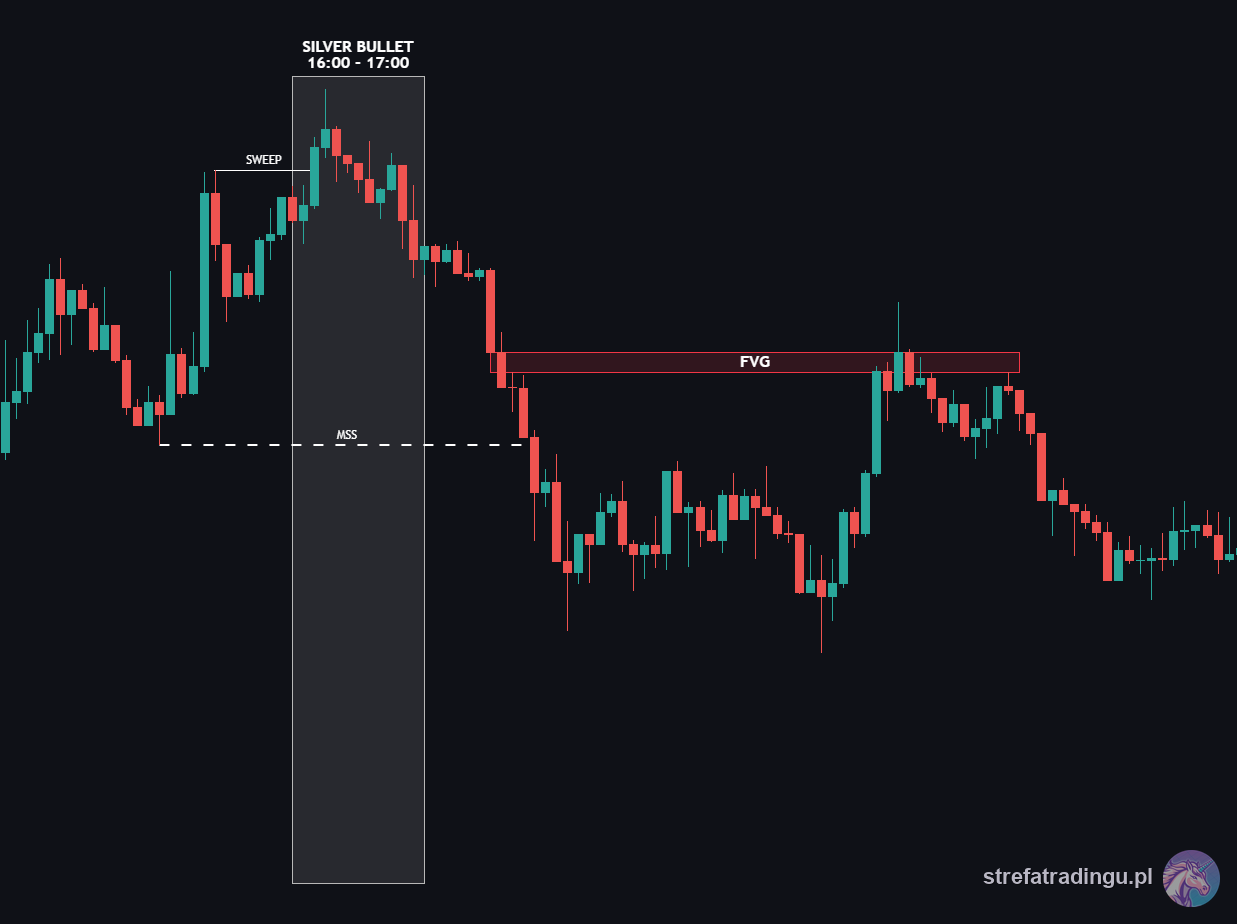
The logic is simple. Price moves for two reasons: to collect liquidity or to rebalance an imbalance. Inside the one-hour Silver Bullet window, both mechanics play out in a predictable order: first the market sweeps a liquidity pool, then it shifts structure on a lower timeframe (Market Structure Shift), leaving an FVG behind along the way — and the return to that gap is the entry.
The Silver Bullet occurs three times in every trading day. ICT anchors all times to New York local time:
| Window | Time (ET) | Character |
|---|---|---|
| London Open SB | 3:00–4:00 AM | London's directional move, good for forex |
| NY AM SB | 10:00–11:00 AM | the strongest window — London + New York overlap |
| NY PM SB | 2:00–3:00 PM | the day's second leg, indices and crypto |
A note on daylight saving time: because everything is anchored to New York local time, the windows never move in ET — but if you trade from Europe or Asia, your offset to New York shifts for 2–3 weeks in March and for about a week around late October and early November. The simplest solution is to set your TradingView chart to the "New York" time zone and read the hours straight off the time axis — and you can watch the current session window live in the NEXUS market clock widget, which tracks the shifts for you.
The NY AM window (10:00–11:00 AM ET) is the strongest of the three: it combines the tail end of the London session with fresh volume after the NYSE open. For anyone trading around a day job in Europe it's also the most convenient hour — after work, over coffee, one hour of focus.
Setup Conditions Step by Step
The Silver Bullet is a mechanical model — either every condition is met or there is no setup. Here's the checklist:
- Before the window opens, mark liquidity on M15. The nearest buy-side pool (highs) and sell-side pool (lows): the previous day's high/low, the previous session's, equal highs/lows. These are your reference levels — details in the article on liquidity pools.
- Decide where price "wants" to go. If the market has already collected liquidity on one side before the window, the opposite side becomes the natural target. If it pushed above a level without turning back — play continuation to the next pool.
- Wait for the window to open. 3:00 AM, 10:00 AM or 2:00 PM ET. No positions "in advance" — a setup outside the window is not a Silver Bullet, even if it looks identical.
- Drop to M1–M3 (M5 at most). These are the execution timeframes; M15 remains the parent chart.
- Watch for the sweep and the MSS. After liquidity is taken, the lower timeframe must break structure toward the next liquidity target. The breaking candle should close decisively — with displacement.
- Mark the FVG from the displacement leg. The gap left by the structure-breaking move is your entry zone. Check that it sits in the correct premium/discount zone relative to the last swing.
- Wait for price to return to the gap. You don't chase the move — half of this model's edge is entering on the pullback, not on emotion.
- Entry, stop, target. Entry inside the gap; stop behind the candle that created it (with a buffer); target at the nearest liquidity pool — typically around 3:1 RR.
- Close or manage the position the same day. The Silver Bullet is a scalp, not a swing — although the target itself may get hit after the window closes, and that's fine.
If you'd rather not draw gaps by hand, ICT All In One, our PRO indicator, marks the freshest FVGs automatically. While you're learning, though, it's worth drawing them yourself first — that way you know what the indicator is actually showing you.
A Worked Example on BTC
Wednesday, the NY AM window. All morning BTC has been building a series of equal highs at 118,400 — textbook buy-side liquidity, marked on M15 well before 10:00 AM ET.
10:04 AM ET: price aggressively breaks the equal highs and reaches 118,620. A sweep — a wick above the level, no continuation. Breakout buyers have just donated their liquidity.
10:11 AM ET: on M3, a full-bodied bearish candle breaks the last local low — Market Structure Shift to the downside. The breaking leg leaves a bearish FVG at 118,350–118,470, in the upper half of the local range (premium — the right place for a short).
10:19 AM ET: price pulls back into the gap. Short entry at 118,400, stop above the high of the candle that created the FVG (118,680), target at sell-side liquidity — the low of the Asian range at 117,550.
11:20 AM ET: target hit — after the window has closed, but it's the setup that has to form inside the window, not the entire trade. RR came out around 3:1.
Note the order of events: time first (the window), then liquidity (the sweep), then structure (the MSS), and only then the entry (the FVG). That sequence is the whole model. If any element is missing — there is no trade, only observation.
Which Window to Pick and Which Market to Trade
In theory you get three chances a day, but in practice it pays to pick one window and learn it inside out — the statistics of one well-mastered window beat chaotic hopping between three.
London Open SB (3:00–4:00 AM ET) is the window for European early birds and forex traders: GBP/USD and EUR/USD move cleanest here, because this is the heart of European liquidity. On crypto it can be temperamental — BTC is often still "finding its feet" after the Asian night, and the sweep can arrive without a readable continuation.
NY AM SB (10:00–11:00 AM ET) is the gold standard. The overlap of late London and a New York in full swing, half an hour after the NYSE open, in the middle of the New York killzone and right after the strongest Macro Time window. Indices, gold, the majors and crypto — everything has fuel here. If you only have time for one window, the choice is obvious.
NY PM SB (2:00–3:00 PM ET) is the "second leg" window: the afternoon continuation or correction of the morning move. On BTC and ETH it can be surprisingly clean, because US volume is still working while Europe is no longer in the way. For European traders with a day job this is often the only realistically available window — and it is entirely enough.
As for timeframes, the division of labour is rigid: M15 is the parent chart (liquidity, bias, targets), M3–M5 is execution, and leave M1 for later — it sharpens entries but also multiplies false MSS signals. The rule from the original model is a healthy one: a hundred logged setups on M5 first, only then move lower.
Realistic Expectations — No Hype
The Silver Bullet gets sold on social media as "one hour a day to financial freedom". The truth is more down to earth.
First, the statistics: there is no independent study of this model's win rate, and the numbers from forums are claims without methodology. You build your own statistics — and even with a positive result, you'll get weeks with three losses in a row. That's normal variance, not a broken model.
Second, frequency: three windows a day does not mean three trades a day. Not every window will produce a clean setup — realistically it's zero to two trades a day, and some days are completely empty. Whoever "forces" a setup in every window is trading noise.
Third, screen time: before you risk real capital, spend at least a few months on a demo account and collect around a hundred logged setups on M5. Only then will your personal statistics tell you whether this model fits your psychology and the market you trade.
Common Mistakes
- Trading outside the window. This is a time-based model — an identical candle pattern at 8:30 AM ET is not a Silver Bullet. The clock matters more than the formation.
- Entering before the MSS confirms. The sweep alone is not a signal. A wick into the gap without a prior structure shift is the setup that ruins your statistics fastest.
- A stop skin-tight behind the gap. The candle that creates the FVG often gets retested deeper. Place the stop behind its wick with a buffer — not a pip past the edge.
- The wrong instrument in the wrong window. GBP and EUR pairs move best in the London Open and NY AM windows; indices and crypto — in NY AM and NY PM. The London Open window on BTC can be far less readable than on forex.
- Closing the position because the window ended. The setup has to form inside the window — reaching the target can take longer. Respect the original stop and target.
- No daily context. A Silver Bullet aligned with the D1/H4 bias and inside a killzone converts noticeably better than one traded "in a vacuum".
The Silver Bullet is the best proof that in the ICT method, time is price's equal partner. If you want to build a complete workflow around it, the next steps are killzones — the broader session context the SB windows live in, the Market Structure Shift — the signal the whole entry hangs on, and the Judas Swing — the twin manipulation model at the session open. And before you place your first trade: spend two weeks just watching the 10:00–11:00 AM ET window on BTC. You'll see the sequence with your own eyes — and you'll understand why it's worth waiting for instead of chasing the market all day.
FAQ
What time is the ICT Silver Bullet?
Which Silver Bullet window is the best?
What is the win rate of the Silver Bullet strategy?

Trader and founder of Strefa Tradingu. He’s been breaking crypto down on YouTube for years — no hype, no signals, with a focus on market structure and risk management.
🎁 Grab Strefa’s free TradingView indicators
Drop your email — we’ll send you links to our free TradingView indicators plus a no-fluff starter kit. Zero spam.
Thank you! Check your inbox. If the email is not there, look in the Promotions tab or in spam and move it to your inbox.