
ICT 2022 Mentorship Model — The Complete Strategy (Sweep → MSS → FVG)
If any ICT model deserves the title of "the one," it's the 2022 Model. It's the model that catapulted the smart money method into popularity: a complete, algorithmic sequence — bias, sweep, structure shift, entry from a gap — that half of trading internet has been copying for four years. And rightly so, because unlike many "YouTube strategies," the 2022 Model has clearly defined conditions: you know when the setup is there and when it isn't. In this article we walk through the entire model step by step — with the session times in ET, a worked example across both sessions, and the list of mistakes that cost the most.
What is the 2022 Model
The 2022 Model is an intraday strategy from Michael Huddleston's 2022 mentorship. It treats price as a delivery mechanism: institutions move the market inside specific time windows in pursuit of liquidity and the filling of imbalances. "Price is nothing without the time." That's why the model doesn't work "all the time," but in two precise windows: at the London open and at the New York open.
The strategy stands on three pillars:
Pillar 1 — the daily bias. The direction of the day established on D1 and H4 before the session even begins. Without a bias, the rest of the model is guesswork — the sweep and the MSS become noise. How to establish it is covered in our article on the daily bias.
Pillar 2 — the session liquidity sweep. The turning point. At the session open, price breaks the high or low of the overnight range against the bias (a classic Judas Swing), collects the stops — and only then does the real move of the day begin.
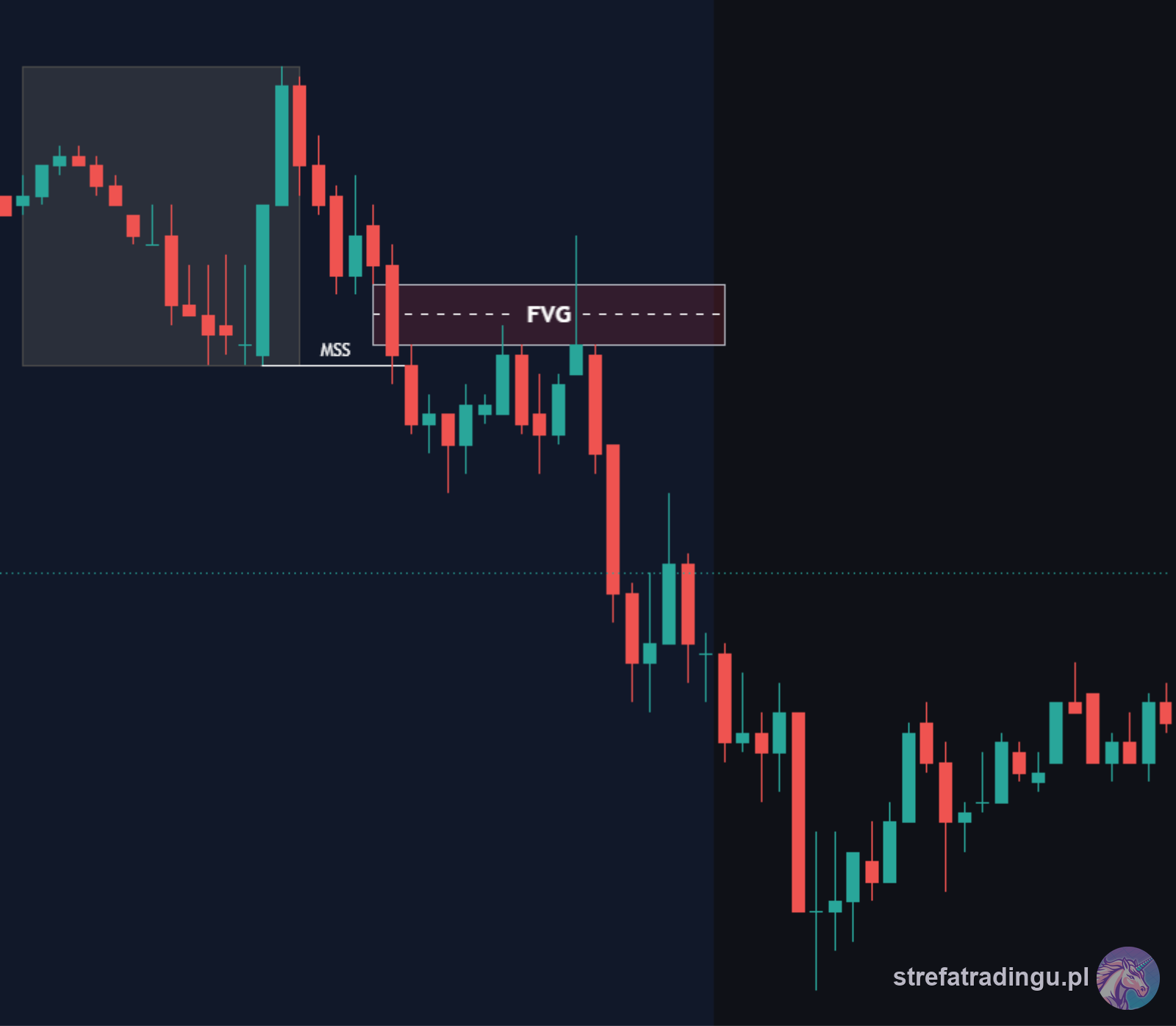
Pillar 3 — the PD Array entry after the MSS. After the sweep, you wait for a Market Structure Shift with displacement on a low timeframe, mark the zone created in the reversal leg (an FVG, order block, breaker) and enter on the pullback into it.
When all three pillars line up — the setup is high quality. When even one is missing — you stand aside. This binary discipline is the model's greatest strength and, at the same time, its most frequently broken rule.
The conditions step by step
The full checklist — ten steps, none of them optional:
- Establish the daily bias on D1 and H4 before the session opens. The direction of the nearest draw on liquidity: which old high or old low the market is most likely heading for.
- Mark the range from midnight ET to the London open (3:00 AM ET). The high and low of that range are your reference levels.
- Wait for the London open. Zero positions beforehand — the model has no pre-positioning.
- Watch for a sweep of the range high or low against the bias. Bearish bias = a sweep of the high; bullish bias = a sweep of the low.
- Wait for an MSS on M5/M3/M1 in the direction of the bias — a break of the last opposing swing.
- Verify the displacement. The candle breaking structure should close decisively and, ideally, leave an imbalance behind. An MSS without displacement is a second-rate signal.
- Mark the PD Array from the reversal leg — an FVG, order block, inversion FVG or breaker block.
- Check the premium/discount zone. The entry zone must sit on the correct side of the range: shorts in premium, longs in discount.
- Wait for the pullback into the zone. You don't chase price — it has to come back to you.
- Execution: entry on the tap of the zone, stop beyond the sweep extreme with a buffer, target at the opposite end of the range or beyond (higher-timeframe liquidity).
The same sequence applies at the New York open — with the New York range instead of the London one, when London was quiet.
The London and New York sessions — two scenarios
London (opens 3:00 AM ET). The base version described above: overnight range, sweep, MSS, entry. London is volatile because it overlaps the London killzone — moves can be fast and deep.
New York (opens 8:00 AM ET) has two scenarios depending on what London did:
Scenario I — London took the liquidity and ran. NY usually delivers a correction and a continuation in London's direction. You stretch a Fibonacci over the London leg, wait for the pullback into the Optimal Trade Entry zone and enter in the direction of the London move after an MSS confirmation on the M1.
Scenario II — London went nowhere. You mark the range from midnight ET to the New York open and trade the full sweep → MSS → PD Array sequence on the New York session. This is the most common variant on days when the macro calendar is concentrated on US hours.
Between 12:00 and 1:00 PM ET the New York lunch is on — price usually stalls or drifts back into the range. That's a window for managing a position, not for new entries.
For a trader in Europe the schedule is actually convenient: the London window falls in the mid-morning local time, and New York opens in the early afternoon — both compatible with a normal daily rhythm, no overnight vigils. Just keep in mind that in the weeks when the US and Europe switch to daylight saving time on different dates, the usual offset between New York and European clocks temporarily shifts by an hour.
A worked example
EURUSD, bearish bias from the daily (market below a daily FVG, the nearest draw on liquidity beneath last week's low). The overnight range into the London open spans 25 pips. At 3:10 AM ET price shoots higher and breaks the range high by 8 pips — buy stops collected. On the M3, a full-bodied supply candle prints, breaking the last bullish swing low and leaving an FVG — MSS with displacement confirmed.
The gap sits in the upper half of the sweep range, i.e. in premium — the zone condition is met. Price returns to the FVG twenty minutes later; short entry in the gap, stop 3 pips above the sweep high, target at the low of the overnight range. The market gets there before 5:00 AM ET, delivering a reward-to-risk better than 3:1. The whole trade played out inside the London killzone window — exactly as the model assumes.
And a counter-example for balance: the same setup, but with an MSS without displacement (a candle barely closing beyond the swing, no imbalance) statistically fails far more often. The 2022 Model doesn't tell you to trade every sweep — only the confirmed ones.
What to trade it on and when
The timeframes are read in this order: D1 (bias) → H1 (levels) → M15 (liquidity maps and imbalances) → M5/M3/M1 (confirmation and entry). The M1 is the sharpest tool and the easiest to cut yourself with — the sensible path is a hundred logged setups on the M5 first.
The hierarchy of liquidity the model targets (from most important): the previous day's high/low, the previous session's, the previous week's, established M15 extremes, and a return to the week's opening gap (NWOG) and the day's (NDOG).
Huddleston ran the mentorship on indices — NQ and ES have the cleanest price delivery in the rhythm of the sessions. On forex, GBP/USD, EUR/USD and gold work best. On crypto the model gets traded too — BTC and ETH have respected the killzones ever since institutional volume came to dominate them — but honestly: an overnight range on a 24/7 market is a convention, and it needs your own verification on historical data before you assume the statistics from indices carry over. The freshest FVGs and order blocks the model tells you to mark are drawn automatically by ICT All In One, our PRO indicator — what's left for you is watching the clock and the structure.
Position management is simple in this model, because the sweep range defines everything: stop beyond the manipulation extreme, first target at the opposite end of the range, further ones at higher-timeframe liquidity. A sensible template is taking half the position off at the edge of the range and moving the stop to breakeven, with the rest run to the previous day's high or low. And one thing the mentorship summaries stay silent about: the model has days without a setup and weeks of reduced accuracy — your trading plan has to account for a losing streak, because a 3:1 setup can still fail several times in a row, and that doesn't mean it has "stopped working."
Most common mistakes
- Trading without a daily bias. The 2022 Model is directional. Without a higher-timeframe bias, the sweep and the MSS are just random candles. The bias is set before the session — not retrofitted afterwards.
- Entering before the MSS confirmation. The sweep alone is not a signal. A wick into the zone without a prior break of structure fails far more often than it works.
- A stop glued to the sweep extreme. The sweep candle often reaches a few pips further before it turns. The stop belongs in the space beyond the sweep wick, with a buffer.
- Ignoring the time windows. A setup that prints at 11:30 AM ET, outside the killzone, is a lower-quality setup — even if it looks identical on the chart. The model is built on time; a chart without a clock is half the information.
- Overleveraging. The 3:1 target is realistic, but only with honoured stops. Risking more than 1% per trade in your first months on this model is a straight road to zeroing out your statistics before they get a chance to work.
- Manufacturing a setup on range days. There are days when neither London nor NY makes a clean sweep. The model simply doesn't occur then — and an "almost-setup" is the most expensive kind of trade.
The 2022 Model isn't the holy grail — it's the skeleton on which an edge is built: through day selection, the quality of your bias and iron execution. Before you put it on the market, master its building blocks: the Market Structure Shift, the Fair Value Gap and the killzones. And then do the thing no mentorship will do for you: a few dozen reps on a demo account with a journal, before you risk your first real dollar.
FAQ
What is the ICT 2022 Mentorship Model?
What timeframes is the 2022 Model traded on?
What should I do when the London session doesn't produce a sweep?

Trader and founder of Strefa Tradingu. He’s been breaking crypto down on YouTube for years — no hype, no signals, with a focus on market structure and risk management.
🎁 Grab Strefa’s free TradingView indicators
Drop your email — we’ll send you links to our free TradingView indicators plus a no-fluff starter kit. Zero spam.
Thank you! Check your inbox. If the email is not there, look in the Promotions tab or in spam and move it to your inbox.